A Reflective Look Back at the Interesting Analogue World
A grounded reflection on life before digital. Lessons from 35mm film, VHS, Morse Code and the analogue world that help us slow down and see more clearly today.

What 35mm Film, Morse Code and VHS Can Teach Us About Slowing Down in a Digital Age
Welcome back to Field Notes For Moden Living. I grew up in the age of analogue TV, VHS tapes and phone boxes. If you didn’t have 10p in your pocket, you weren’t calling anyone. Music lived on cassettes. Games came on cartridges. And if you wanted to watch a film, you either went to the cinema or hoped the tape wasn’t chewed up by the family VCR.
I learned Morse Code during my Army apprenticeship. It felt like magic at the time, tapping out messages across the ether. Slow, simple, reliable. A world away from the instant everything we have now.
And then there were photographs.
Back then, developing photos took a week. You loaded a film roll into a 35mm camera, wound it on carefully, hoped it caught the sprockets, then carried on with your day capturing moments you wouldn’t see again until the envelope came back from Boots.
What 35mm Actually Was
If you’re from that era, you’ll remember the feel of it. The click of the shutter. The satisfying wind of the film advance. The small, hopeful pause before taking a second shot because you only had 24 or 36 frames and every one mattered.
For anyone who didn’t grow up with it, here’s the short version.
A 35mm camera used a strip of light-sensitive film, 35 millimetres wide, stored inside a neat little metal cartridge. Each time you pressed the shutter, light hit the film and burned an image into the chemicals coated on the surface. Then you’d wind it on by hand so the next blank bit was ready.
It was simple, imperfect and brilliant. You couldn’t delete anything. You couldn’t check the screen. You lived with whatever you captured. Sometimes that was a masterpiece. Sometimes it was your mate’s elbow.
Why It Mattered
Looking back, the slowness was the whole point. The discipline. The anticipation. The delayed gratification of picking up that envelope and flipping through physical prints.
It taught you to look properly.
To wait.
To choose a moment rather than spray and pray.
There’s something in that lesson we could use now. A reminder that not every moment needs to be uploaded, edited or filtered. Some things are better when we give them time to settle.
A Small Reflection for Modern Life
Technology today is astonishing. Cameras on our phones capture more detail than any film stock we had in the 90s. But part of me misses that quiet ritual of taking a photograph and trusting it to the process.
Maybe clarity comes from slowing down long enough to notice.
Maybe that’s why so many people are going back to film.
Not out of nostalgia, but because the world feels better when we stop rushing through it.
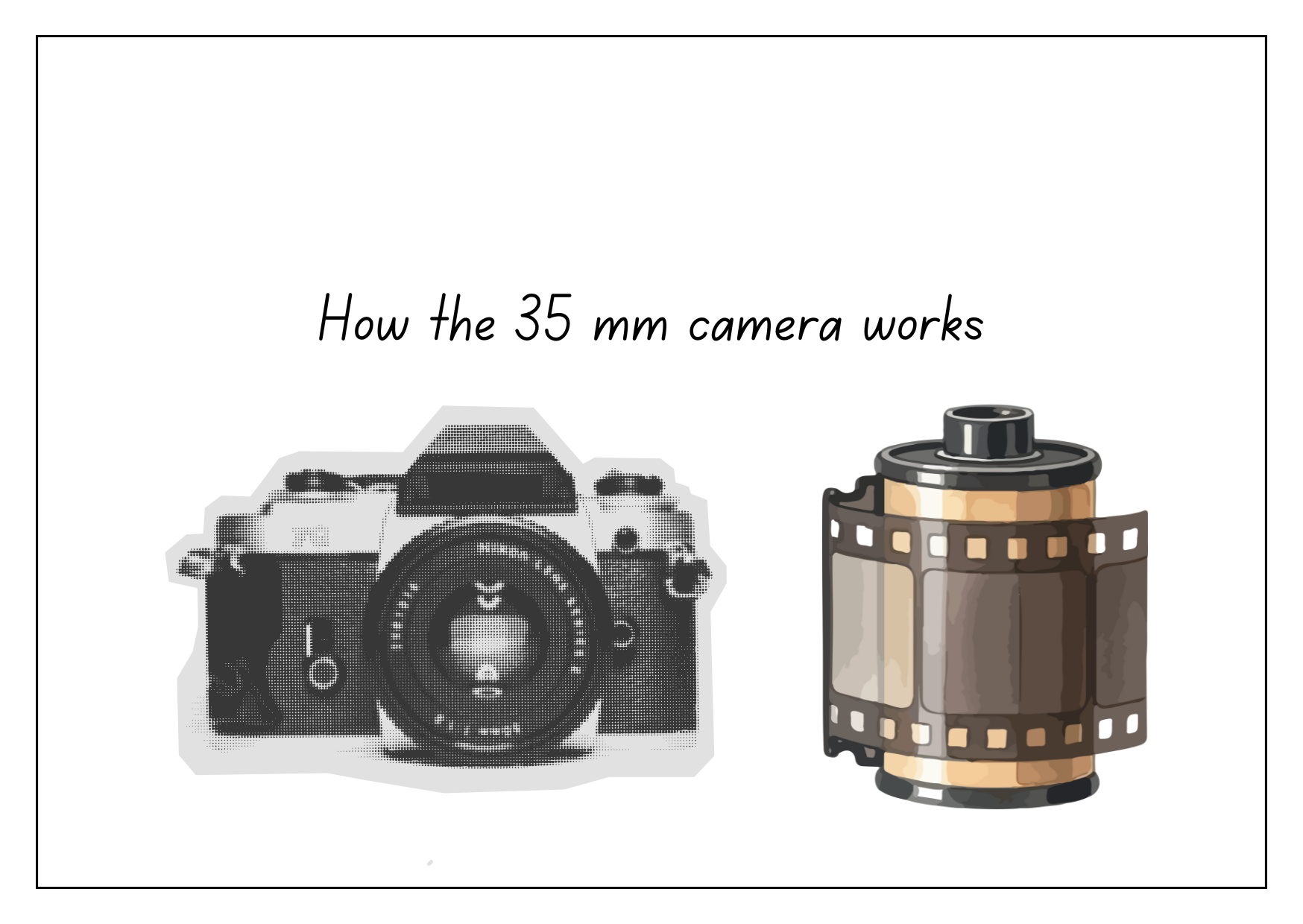
A 35mm camera is a type of film camera that uses 35mm-wide photographic film to capture images, the same format that defined much of 20th-century photography and cinema.
Here’s a breakdown of what that means and how 35mm cameras work
🎞️ The Basics
- “35mm” refers to the width of the film strip (including the perforations on each side).
- Each frame on the film measures 24mm high x 36mm wide, giving a 3:2 aspect ratio, the same shape as most modern digital photos.
- The film is wound inside a light-tight cartridge that you load into the back of the camera.
📸 How It Works
- Loading the film: You place the 35mm film roll into the camera and pull the film leader across to the take-up spool.
- Advancing and shooting: Each time you press the shutter button, the camera exposes one frame of film to light. The film then advances to the next unexposed section.
- Exposure: Light passes through the lens and shutter, hitting the light-sensitive film. The combination of shutter speed, aperture, and ISO (the film’s light sensitivity) controls exposure.
- Developing: After shooting, the film is rewound, removed, and developed chemically to reveal the negatives.
- Printing or scanning: The negatives are then either printed onto photo paper or digitally scanned for editing or sharing.
⚙️ Types of 35mm Cameras
- Manual SLR (Single-Lens Reflex): Uses a mirror and prism system so you see exactly what the lens sees. Examples: Canon AE-1, Nikon FM2, Pentax K1000.
- Rangefinder: Focus is achieved using a split-image window, not through the lens. Example: Leica M series.
- Compact point-and-shoot: Fully automatic, ideal for casual use. Example: Olympus Mju-II, Canon Sure Shot.
- Disposable cameras: Pre-loaded with film and used once.
📷 Why People Still Love 35mm
- Film look: Rich tones, subtle grain, and natural contrast that digital cameras often try to imitate.
- Tactile experience: Physically loading film, winding the lever, and hearing the shutter click.
- Creative discipline: With only 24 or 36 shots per roll, you think more carefully before pressing the shutter.
- Archival quality: Properly stored film negatives can last for decades.
A reflective look back at the analogue world many of us grew up in. From VHS tapes and phone boxes to Morse Code and 35mm film, this post explores a slower, simpler time when technology demanded patience and intention. I hope you liked my explaination of how 35mm cameras worked, why film photography shaped the way we saw the world, and what those old rituals can still teach us today. In an age of instant everything, the analogue era reminds us to slow down, choose our moments, and trust the process.
Give me a like if you still shoot with 35mm.