Using Provocative Midjourney as a Simple Mindful Creative Practice
Create art with Midjourney using human intent, moodboards and prompts. A look at Signals After the Storm and why the process feels therapeutic.

Create a New World with AI: Signals After the Storm
One of the most important things about being a writer is observation. Not just what's going on around us, but what's happening behind the scenes. Artificial Intelligence (AI) is prevelant in our lives. Google lens, Tripadvisor, you name it organisations and people are using it. I've alays loved the idea of being able to draw, but to be frank, I don't have the talents. That's when I stumbled on Midjoureny. The edition of Field Notes for Modern Life looks at my first project.
The Process of using Midjourney
At first I was a bit overwhelmed by the platform, but after an hour I started to create mood boards and I was fasicinated with the 'art' of possibilities.
I see AI art a bit like writing. You need patience and an imagination.
Signals After the Storm
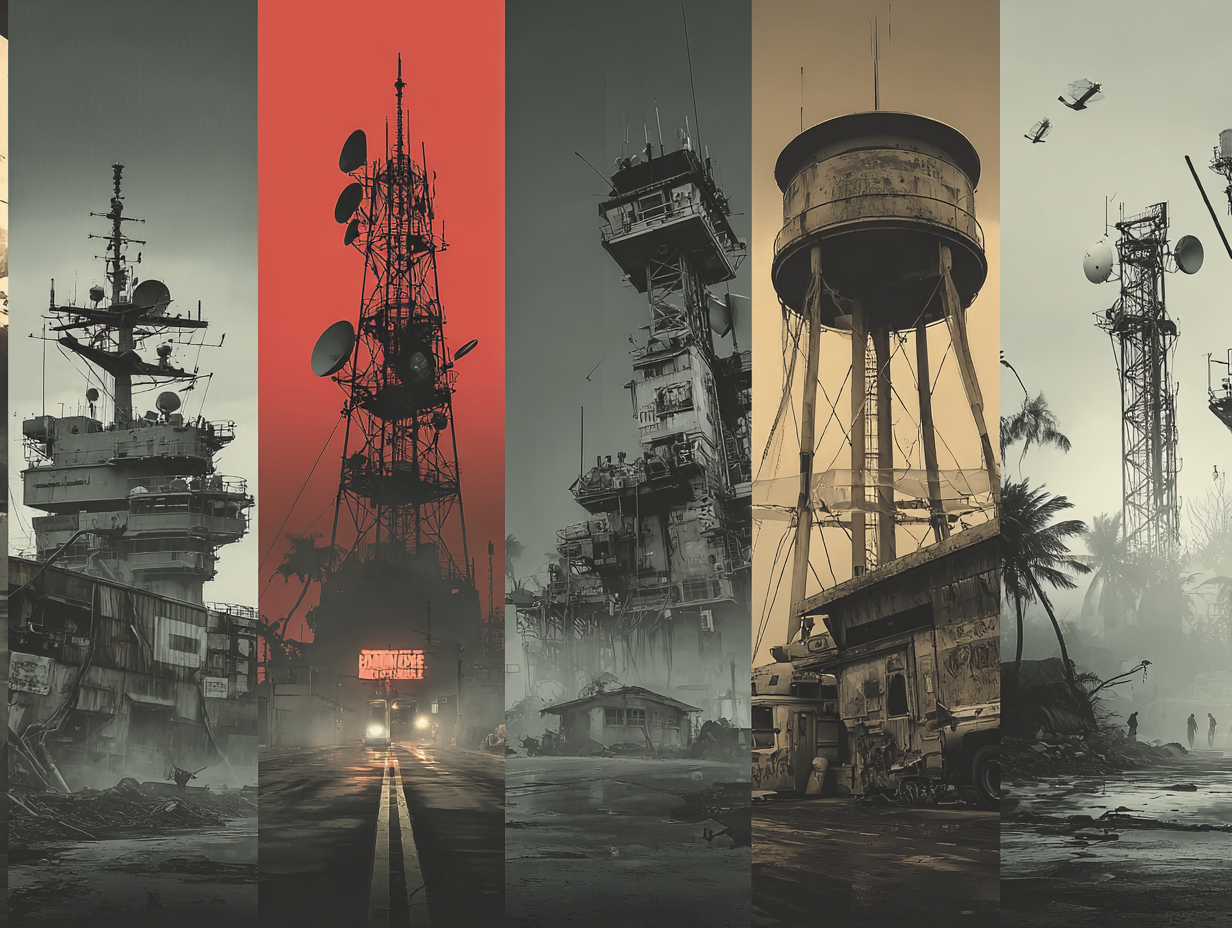
I created a moodboard and than asked Midjourney to create a new world.
The world you’ve built is made of listening
In the image, the first thing that hits you is height.
Not skyscrapers. Not monuments. Not anything celebratory.
These are working structures. Radio masts. Antenna farms. Control towers. A water tank on spindly legs, like a mechanical stork. The upper decks of ships that look too tired to sail, yet still refuse to sink.
It’s a world rebuilt around one need, to keep receiving.
Midjourney Is Not the Artist, You Are
I keep coming back to one idea whenever someone shrugs and says, “AI does it all for you.” It really does not.
Midjourney can generate the pixels, but it cannot decide what you are trying to say, what you want to feel, or what you want the viewer to notice first. That part is still yours, and for me, that is the whole point.
The image above is a good example. It is not “a random AI picture”. It is a set of choices that ends up looking like a story.
A reference point: a world made of signals
What I like about this piece is how it reads like five postcards from the same broken coastline.
You have towering antenna masts and dish arrays, a battered ship superstructure that looks half museum and half warning, a wet road pulling your eye towards a glowing sign in the distance, and a water tower standing like a bored sentry. Add the fog, the muted palette, the helicopters scratching across the sky, and it starts to feel like you have arrived after something has happened, and before anyone is ready to explain it.
There is structure in it, not just subject matter. The vertical panels create rhythm. The colour choices do a lot of emotional work, especially that single red column that looks like an alarm bell in the middle of an otherwise dusty world. Even the “empty” space has a job, the haze gives the scenes room to breathe.
None of that appears by accident. Not in the prompt, not in the selection, not in the final layout.
The human input in is the creative part
When I make something like this in Midjourney, I am not pressing a button labelled Make Art.
I am making a sequence of decisions, very similar to photography:
- What is the subject? (signal towers, industrial relics, water tower, aircraft silhouettes)
- What is the mood? (quiet tension, aftermath, coastal fog, surveillance)
- What is the composition? (tall structures, low horizon, a road as a leading line)
- What is the palette? (desaturated greys and sand tones, one hard red accent)
- What is the format? (a multi-panel set, consistent framing, coherent “series”)
- What is the edit? (which variations make the cut, what gets cropped, what sits next to what)
Then there is the most overlooked part. Stopping. Choosing the final image is a human decision. Knowing when it is finished is a human decision. Resisting the urge to keep generating forever is, honestly, the most human decision of all.
Prompting is closer to direction than typing
A good prompt is not a magic spell. It is a brief. It is you telling the tool what matters.
If I wanted to build towards the feeling in this image, I would think in layers:
- The nouns: communications towers, radar dishes, derelict ship, water tower, palm trees, helicopters, wet road
- The world: foggy coastal industrial zone, post-crisis, abandoned infrastructure
- The camera language: low angle, tall verticals, cinematic contrast, soft haze, depth
- The art language: desaturated tones, grain, restrained colour, one red accent
- The layout: a five-panel vertical collage, consistent style across panels
Here are a few example prompts in that spirit (use them as scaffolding, not scripture):
Panel series prompt (coherent set):
five-panel vertical collage, abandoned coastal communications outpost, radar towers and antenna masts, derelict naval superstructure, foggy atmosphere, wet asphalt road with distant headlights, water tower on stilts near palm trees, two helicopters in hazy sky, cinematic composition, desaturated greys and sand tones with one bold red panel accent, high detail, film grain, moody lighting
Single image prompt (one “card” from the set):
towering radar mast with dish antennas, coastal fog, industrial decay, cinematic low angle, muted colour palette, soft haze, dramatic sky, film grain, minimal human presence
More abstract, less literal:
a world built from signals and silence, tall skeletal towers, distant engines in fog, muted tones, one warning-red colour block, cinematic framing, quiet tension
The point is not to copy these words. The point is to notice what you are doing when you write them. You are deciding the story.
Why Creating AI Art feels therapeutic for me
This is the bit I did not expect when I first started.
Midjourney, used well, is a structured way to calm your mind because it gives you a small, controllable creative space. You begin with a messy feeling or half-formed idea, then you translate it into something concrete, word by word. That translation is soothing. It is organising.
The process slows me down in a way that modern life rarely rewards:
- You have to pay attention (what exactly do I mean by “moody”, what kind of moody?)
- You have to make choices (this version is noisier, that version is cleaner, which matches the feeling?)
- You have to accept iteration (close, not quite, try again with one change)
- You have to let go (good enough, saved, move on)
It becomes less about chasing perfection and more about finding the version that feels true. In that sense, it is closer to journalling than it is to “content creation”. The images are the by-product. The real value is the focusing act of making them.
A simple mindful workflow you can use
If you want to keep the process human and calming, not frantic and scroll-addicted, this is a reliable approach:
- Start with one emotion, not one aesthetic.
“Unease”, “nostalgia”, “quiet”, “awe”, “relief”. - Pick three anchors.
One subject (tower), one atmosphere (fog), one colour constraint (muted with one red accent). - Generate small, then refine.
Adjust one variable at a time so you can feel cause and effect. - Curate like an editor.
Save only what fits the series, not what looks impressive in isolation. - Sequence it.
Put images next to each other and notice what story appears between them, like the panels in the reference image. - Write one sentence.
A caption, a title, a note to yourself. This keeps the work connected to your intent.
Keeping it human on purpose
There is a temptation to treat Midjourney like a slot machine. Pull the lever, hope for a jackpot, repeat.
I try to do the opposite. I use it like a sketchbook.
The more intention you bring, the more personal the output becomes. That is how you get a piece like the reference image, not just five nice pictures, but five related frames that share a world, a palette, and a pulse.
Midjourney can generate the scene, but you decide what it means. That is the human bit, and for me, it is the therapeutic bit too.
The use of AI will always attract teh