Christmas, Lonely Venezuela and the Fragile Comfort We Crave
A Christmas field note linking Berlin 1987, Britain’s cost of living, Venezuela’s hyperinflation and Trump-era power politics with Russia and China.

Venezuela’s hyperinflation and Trump’s renewed power politics
It is nearly Christmas, and my mind goes back to the last White Christmas I can clearly remember. Berlin, 1987. Proper snow. The kind that silences a city. Sledges, snow shovels, teenagers launching snowballs at tower blocks. For a boy, it felt simple. Presents, family, the smell of food and cold air on your cheeks.
It is only as an adult that you realise how much conflict sat behind those quiet flakes. Berlin was still a divided city, caught between superpowers, a symbol as much as a place. The world felt tense, but our own little street still found room for snowmen and fairy lights.
This December, looking at a soggy English sky, my thoughts drift somewhere very different: Venezuela. Another place where great power games and domestic misrule collide, but where the snow never comes and the numbers are written in red.
Venezuela A Nation in Permanent Crisis
Venezuela has not been at “war” in the way we think of Ukraine or Gaza, yet it is absolutely a country in conflict. A slow, grinding one. Over the last decade it has moved from being one of Latin America’s wealthier petro-states to a byword for economic collapse and political repression. President Nicolás Maduro and his circle have held on to power while democratic institutions, independent media and basic freedoms have been steadily choked (Council on Foreign Relations).
How much did inflation reach in Venezuela?
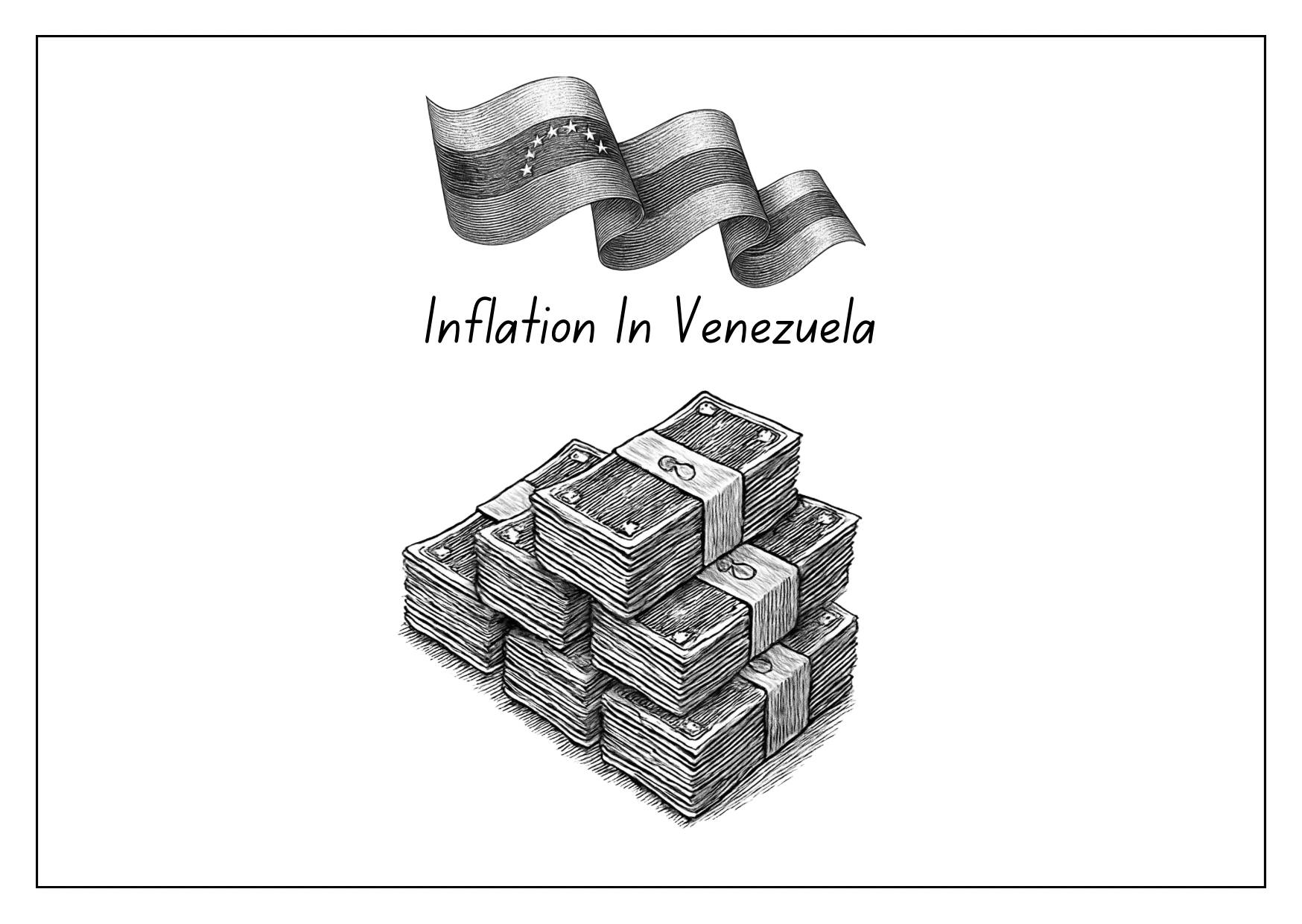
The economy has been through a hyperinflationary storm that makes our cost of living crisis look almost quaint by comparison. In 2019, inflation reached over 63,000 percent.
Money stopped behaving like money. Prices changed between morning and afternoon. People were paid in bundles of notes that would not buy food by the end of the week.
When you and I talk about inflation, we are usually thinking about the weekly shop, the energy bill and whether the mortgage will creep up again. Those are real pressures. UK inflation has sat around 3 to 4 per cent this year (Office for National Statistics). In Venezuela, even after the “improvement”, a year can still vaporise most of the value of your savings. That is not a squeeze, it is a slow erasure of normal life.
What the United States has been doing
Layered on top of Venezuela’s own political and economic mismanagement is the weight of outside pressure, most of it American.
For years Washington has used sanctions as a tool to squeeze the Maduro government. Under Trump’s first term, the US moved from narrower, targeted sanctions to far broader measures aimed at the government and its vital oil sector. Executive orders in 2017–2019 restricted access to US financial markets, blacklisted state oil company PDVSA and, in 2019, froze the assets of the Venezuelan government in the United States and barred most transactions with it. (Congress.gov)
The stated goal was straightforward: force Maduro from power or at least to the negotiating table. The reality on the ground has been messier. Sanctions have added pressure on an economy that was already collapsing under corruption, mismanagement and falling oil production. They have limited the regime’s room for manoeuvre, but they have also made it harder for ordinary people to import food, medicine and spare parts, especially when companies elsewhere are frightened of tripping over US rules.
In Trump’s second term, the pressure has not eased. His administration has added a 25 per cent tariff on buyers of Venezuelan oil, and US officials have been looking at how Venezuela uses creative methods, including crypto, to get its crude to market. More recently, Trump has urged airlines to treat Venezuelan airspace as closed, while US forces step up patrols and presence in the Caribbean (Washington Post).
Seen from Caracas, Washington is not a distant referee, it is an active player.
Christmas in Britain, queues in Caracas
In Britain, our cost of living narrative has become a kind of national background noise. We complain about food prices, look nervously at energy bills and grumble about the Bank of England. We are right to. Inflation of 3.6 per cent still hurts when wages are flat and everything from train tickets to water bills creeps upwards. (Office for National Statistics)
Yet it is worth holding those numbers next to somewhere like Venezuela.
Imagine living in a country where triple-digit inflation is the “new normal”. Where your monthly wage might cover food for a week. Where you do not simply fear a surprise at the till, you fear the shelves being empty. Where families have to choose which meals to skip, and millions have already left the country entirely in one of the world’s largest displacement crises. (Council on Foreign Relations)
Our problems are real. They are not the same.
That is not an invitation to guilt, just perspective. Sitting at a British kitchen table, looking at the rain and working out how to stretch a Christmas budget, it is easy to feel squeezed and hard done by. I often do. It is also possible, in the same breath, to remember that in other parts of the world, the numbers have gone feral.
Is Trump just flexing for Moscow and Beijing?
Which brings us back to power politics.
Donald Trump is back in the White House, the 47th president, after winning the 2024 election. His government has revived an “America First” foreign policy with sharper edges. In the last few weeks he has told airlines to avoid Venezuelan airspace, labelled Maduro’s circle as part of a drug trafficking organisation and even used terrorism designations (Washington Post). US ships and aircraft are more visible in the Caribbean again.
So is this really about Venezuela, or is it about Russia and China?
Both Moscow and Beijing have interests in Caracas. Russia has supplied arms and provided diplomatic cover in the UN. China has extended loans and invested in oil, though it has been more cautious in recent years as the crisis deepened (CFR).
Seen in that light, Venezuela becomes more than a struggling state. It turns into a stage. A place where Washington can signal to its rivals that it can still hurt a government they support, can still move ships into their neighbourhood, can still dictate terms in the Western Hemisphere.
Some analysts read Trump’s latest moves, from tariffs to talk of airspace and military options, as part of that signalling game, a kind of strategic chest beating for Moscow and Beijing’s benefit. (Atlantic Council) Others argue it is more domestic, designed for a base that likes strongman language and simple villains.
The honest answer is that it is probably both. Foreign policy is rarely pure. There is always a blend of signalling, ideology, theatre and genuine concern.
Fragile comforts this Christmas
So where does that leave us, on a damp December afternoon in Britain, thinking about a distant country in crisis?
For me, Venezuela is a reminder that comfort is fragile. That the boring things we assume will always function, like money holding its value, shelves being stocked and roads being safe, depend on layers of competence and restraint that can be eroded faster than we think.
It is also a reminder that when superpowers start using smaller countries as message boards to each other, it is ordinary people who pay the price. Venezuelans are not pieces in a game between Washington, Moscow and Beijing, but they feel the consequences every time a new set of sanctions lands or the prospect of airstrikes appears in the headlines.
Back in Berlin in 1987, I had no idea how much history my snowball fights were sitting on. This Christmas, in a Britain still wrestling with its own cost of living crisis, I will probably still complain about the price of the turkey. But I will also keep one eye on the places where inflation is not a line in a budget speech, it is a force that empties streets and pushes people across borders.
Those are the real field notes from our modern world.